4 min read

DE-BANKED: What Jack Mallers’ Clash With JPMorgan Reveals About the Future of Money

DE-BANKED: What Jack Mallers’ Clash With JPMorgan Reveals About the Future of Money

By Andrew Campbell for The Bitcoin Pivot

A rising Bitcoin innovator gets locked out of his bank and sparks a generational fight over who really controls financial access.

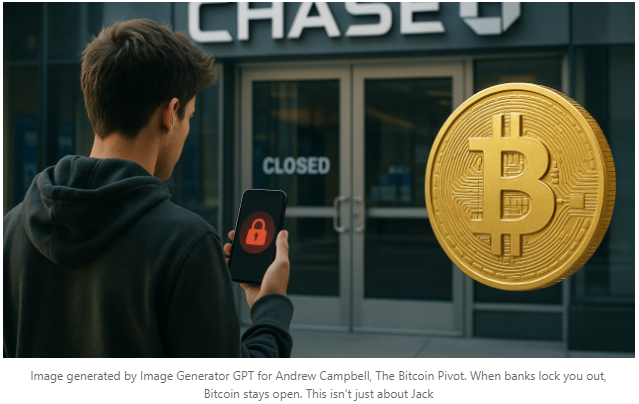
When Jack Mallers opened his banking app one ordinary afternoon, he didn’t expect to find himself locked out of his own financial life. Yet with a single corporate decision from JPMorgan Chase, the 30-year-old CEO of Strike, one of Bitcoin’s most disruptive payment platforms, was suddenly cut off from the accounts that power everyday life.

For Mallers, a builder who has spent his career challenging the structures of traditional finance, the irony was impossible to ignore. But this wasn’t just a personal inconvenience. For a modern generation already skeptical of institutional power, the de-banking of a Bitcoin innovator raises urgent questions about who controls access to money in the digital age and whether the future belongs to banks or open financial networks built for global participation.

A Shock That Shouldn’t Be a Surprise

News of Mallers losing his access spread quickly through both the tech world and the financial press. Yet beneath the surface, the story reflects a long-building tension. Decentralized innovation is accelerating while legacy institutions still decide who gets permission to participate.

Today’s younger adults, many of whom grew up online and experienced financial instability firsthand, tend to trust banks far less than older generations. Surveys consistently show that only a small fraction of younger people say they trust banks “a lot,” even though they still rely on them for daily life. Many watched inflation shrink their wages and saw financial opportunities narrow in ways previous generations did not.

Mallers’ sudden loss of access illustrates exactly why a growing number of people are exploring alternatives. When your ability to use your own money can be removed without warning, the appeal of a system that does not require permission becomes much easier to understand.

Who Is Jack Mallers and Why Banks Take Notice

To understand the significance of this moment, it helps to understand the messenger. Jack Mallers does not resemble a traditional finance executive. He communicates plainly, dresses casually, and focuses on building technology that empowers ordinary people. His approach resonates with digital natives who value transparency and authenticity.

As founder and CEO of Strike, Mallers helped bring the Bitcoin Lightning Network into mainstream relevance by enabling fast, inexpensive global payments. His public talks, often energetic and emotionally honest, challenge a financial system defined by rising costs and diminishing purchasing power. He once summarized his perspective with a simple, pointed line:

“The best time to buy groceries with your dollars was 1913. Every year since, your money has gotten weaker.”

For many younger people navigating rising rents, unpredictable job markets, and shrinking financial security, that statement hits close to home. And when a major bank shut off Mallers’ access without warning, his critique suddenly carried more weight.

What JPMorgan’s Decision Really Means

Financial Access Is Conditional, Not Guaranteed

JPMorgan’s actions reveal a truth most people never think about until it affects them personally. Your ability to participate in the banking system exists at the discretion of institutions. Even innovators working on the future of finance are not exempt.

Bitcoin Challenges the Traditional Model

Strike’s technology does not depend on bank approval. It enables value to move globally without intermediaries. For institutions used to controlling money flows, this represents a profound challenge.

The Meaning of “Safety” Is Changing

Banks have long positioned themselves as the safe, stable alternative to new technologies. Yet in this scenario, the bank revoked access while Bitcoin continued operating around the clock. That contrast is difficult to ignore.

This Is Part of a Larger Pattern

The conflict between Mallers and JPMorgan reflects a broader cultural and technological shift. With each similar incident, more people question whether traditional systems still operate in their interest.

Why This Moment Resonates With Younger Readers

No generation has been more prepared to question institutions than today’s young adults. They have lived through economic crises, rising inequality, and a rapid shift toward digital life.

To many, Mallers’ experience feels familiar rather than surprising.

They Want Systems They Can Control

Younger people increasingly seek financial systems where access cannot be revoked without explanation. Bitcoin offers exactly that kind of autonomy.

Money Should Work Like the Internet

Fast. Global. Borderless. Without unnecessary barriers. This aligns with the expectations shaped by every modern digital experience.

A Practical Path to Independence

For many, turning to Bitcoin is not an act of rebellion. It is a logical step toward regaining agency in systems that often feel outdated or indifferent to their reality.

What Everyone Should Take Away From This Moment

  1. Your Access to Money Can Be Restricted
  2. Alternative Systems Are Becoming Essential
  3. The Future Will Be Built Beyond Legacy Banking
  4. This Moment Represents a Cultural Turning Point

What You Can Do in 3 Simple Steps

  1. Reduce Dependence on a Single Bank
  2. Learn the Basics of Self-Custody
  3. Try a Lightning Payment

These small steps create confidence and reduce your vulnerability to unexpected disruptions.

The Bigger Picture

Jack Mallers did not choose to become the center of this debate, but his experience exposes something that is increasingly difficult to ignore. Institutions are no longer the sole gatekeepers of financial participation. People are turning toward technologies that offer stability, transparency, and a sense of agency.

For readers of The Bitcoin Pivot, this is not just another crypto headline. It is a preview of a future where access is open, power is distributed, and money becomes something you control rather than something controlled for you.

And in that future, the most important question is no longer whether banks approve.

It is whether you are prepared to take control.