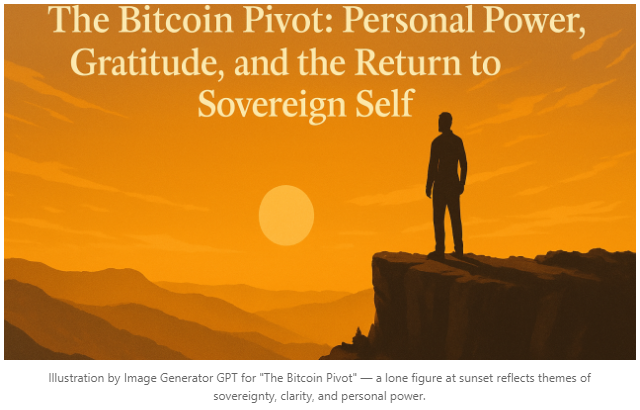
The Bitcoin Pivot: Personal Power, Gratitude, and the Return to the Sovereign Self
By Andrew Campbell for The Bitcoin Pivot
Most people don’t notice powerlessness when it first enters their lives. It rarely arrives as a dramatic event. Instead, it seeps in quietly, through the bill that keeps rising, the savings that never seem to grow, or the low-grade anxiety that whispers, you’re not really in control. Over time, these small frustrations accumulate until people begin shrinking their plans, shortening their timelines, and lowering their expectations for the future.
They don’t stop dreaming.
They simply stop trusting their dreams.
This feeling has become widespread. Recent surveys from the American Psychological Association consistently show that money remains one of the most common sources of stress for Americans. Around the world, inflation, currency instability, and political turmoil have conditioned millions to expect loss rather than stability. Psychologists call this “learned helplessness,” when repeated experiences of limited control teach individuals to stop trying, even when a way out eventually appears.
But in the midst of this quiet despair, something unexpected has been happening. Late at night, in WhatsApp groups, YouTube rabbit holes, and kitchen-table conversations, people have been rediscovering a sense of agency through a tool they never anticipated: Bitcoin.
At first glance, Bitcoin seems like a purely technological or financial phenomenon. Yet for many who adopt it intentionally, who study it, engage with it, and build habits around it, it becomes something deeper. A psychological turning point. A reorientation of identity. A reminder that personal power doesn’t originate from institutions but from the individual.
This realization becomes clear through lived stories.
A schoolteacher in Buenos Aires once described the moment she saved her first wages in Bitcoin during a year of crushing inflation. “For the first time,” she said, “my money didn’t evaporate. I didn’t know money could feel like safety.” Her gratitude wasn’t about wealth; it was about stability, a feeling rarely available in her environment.
A graphic designer in Lagos shared something similar. Frequent currency issues made long-term planning nearly impossible. When he began accepting Bitcoin, he said, “I finally felt like I could think ahead.” For the first time, five years felt imaginable, not absurd.
An auto mechanic in Ohio spoke about how understanding Bitcoin improved his home life. “Once I understood money,” he said, “I became calmer. More patient. A better dad.” He didn’t talk about charts or price targets. His story was about presence and returning to a steadier version of himself.
What connects these stories is that when people regain control over their financial reality, their inner world changes as well.
Research across psychology and behavioral economics consistently suggests that greater autonomy increases confidence, long-term thinking, and emotional regulation. When individuals trust that their savings will hold value, their time horizon naturally extends. Stress decreases. Gratitude increases. And gratitude, in turn, is one of the most powerful stabilizers of human emotion, known to boost resilience and broaden focus toward possibility rather than fear.
Bitcoin, by its design, enables this shift.
Its fixed supply revives the simple but radical idea that money can hold value over time.
Its decentralization reduces the fear that rules may change without warning.
Its model of self-custody invites individuals into responsibility, not as a burden, but as an expression of capability.
Each of these elements nudges people back into alignment with themselves.
They begin thinking long-term again.
They make decisions with intention rather than panic.
They feel calmer, more grounded, more grateful.
Not because Bitcoin makes life easy, but because it makes life coherent.
This is why so many describe Bitcoin not just as financial infrastructure, but as personal infrastructure. It doesn’t only store monetary value. It stores emotional value: stability, autonomy, self-respect. It helps people rebuild their relationship to time, work, and their own potential.
This is the real Bitcoin Pivot.
Not a shift in technology or markets, but a shift in the human heart, a moment of remembering that we are allowed to imagine a future again. That we can hold our own keys, literally and metaphorically. That sovereignty is not a luxury, but a birthright.
Bitcoin does not give people power.
It reminds them of the power they already possess, and teaches them how to protect it.
And in that remembrance, gratitude returns.
Not the fragile kind that collapses under pressure, but the deep, grounded form that comes from clarity and self-trust.
The kind that says: I know who I am again.
The kind that says: I can build a future worth being grateful for.