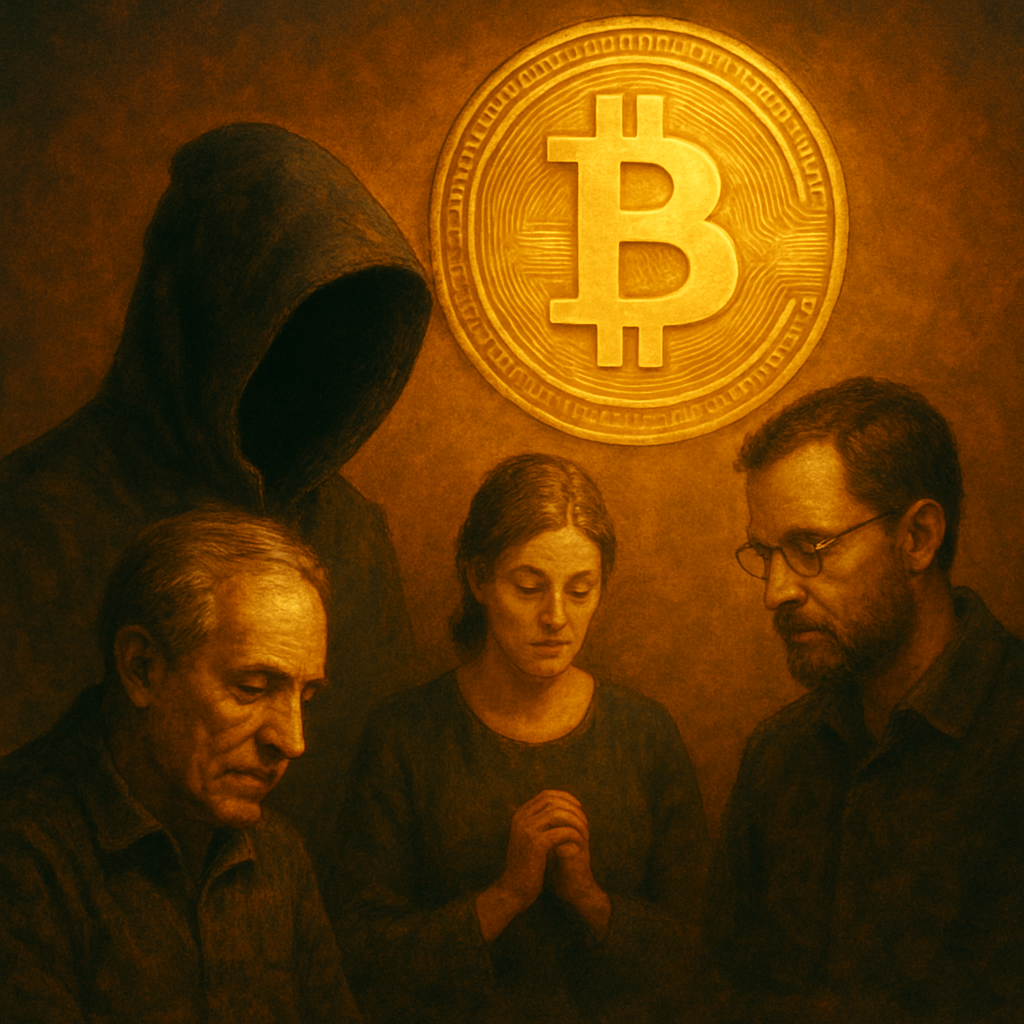
Satoshi Nakamoto
Every technological revolution carries two stories. The first is the one we notice: the invention itself, the dramatic breakthroughs, the public debates, the loud proponents and louder critics. This is the story that fills headlines and sparks controversy. But beneath that visible layer lies another narrative, quieter and more enduring, populated by people whose contributions do not announce themselves. Their influence emerges not from force, but from temperament.
Bitcoin, more than any innovation of the modern age, reveals this hidden story. Its most important contributors often work in silence. Its most meaningful decisions occur in the shadows of mailing lists, code reviews, late-night discussions, and solitary acts of stewardship. And the people who move Bitcoin forward do so not through spectacle, but through qualities that are strikingly countercultural: humility, patience, restraint, precision, generosity, vigilance, and steady conviction. These are the virtues the ancient traditions called “meekness,” though the modern world seldom honors them.
This series began with a simple idea: what would happen if we explored Bitcoin not through its price charts or its ideological battles, but through the quiet character of the people who built and sustained it? What if we shifted our gaze from the loudest personalities to the soft-spoken architects who shaped Bitcoin’s foundations? What if we looked for the deeper emotional logic of a technology often described as cold or mechanical?
As the chapters unfolded, a portrait emerged, not just of individuals, but of a collective temperament. Satoshi’s disappearance was not an act of withdrawal but a gesture of discipline. Hal Finney’s gentle optimism offered a moral warmth that shaped early culture. Adam Back’s steadiness provided continuity. Pieter Wuille’s precision gave the system elegance and safety. Educators extended patience to millions of beginners. Maintainers guarded Bitcoin’s integrity with vigilance and modesty. And holders across the world, through quiet personal discipline, gave Bitcoin its resilience.
Together, they revealed something profound: Bitcoin is not just a protocol. It is a community shaped by virtues that are easy to overlook in a world obsessed with spectacle. This project invites us to reconsider who truly builds movements and what kind of temperament sustains them. The meek may not inherit the earth, but within Bitcoin, they have inherited something equally meaningful, responsibility.
What follows is not only a chronicle of Bitcoin’s early figures, but a meditation on the emotional architecture that makes the system possible. In honoring the meek, we illuminate the foundation on which all revolutions ultimately depend.
The Meek Bitcoiners: Part 1

The Quiet Architect: Satoshi Nakamoto’s Radical Humility and Bitcoin’s Beginning
In January 2009, as the global financial system sat in the rubble of the previous year’s collapse, a modest email appeared on the cryptography mailing list. “I’ve developed a new open source peer-to-peer e-cash system called Bitcoin…,” it began, plain, technical, and strikingly reserved for what it introduced. There was no biography, no résumé, no personal detail. The author signed only a name no one recognized: Satoshi Nakamoto.
From this quiet beginning, Bitcoin entered a world searching for alternatives yet unprepared for what was coming. And while the technology itself would soon ignite fierce debates, its creator demonstrated a temperament that felt both rare and essential, a kind of strength expressed through restraint. At The Bitcoin Pivot, we have long believed that decentralized systems depend not only on code but on emotional architecture. Satoshi’s behavior offers one of the earliest and clearest examples of the meekness such systems require.
Satoshi’s emails and forum posts reveal a figure consistently calm, patient, and disinclined toward self-importance. Their communications rarely betrayed frustration, even when faced with pointed criticism. In one of the earliest exchanges, in November 2008, a longtime participant in the mailing list challenged whether Bitcoin’s design could scale securely or resist attack. Rather than defending the project with bravado, Satoshi responded with clarity and technical explanation, engaging the critique without ego. This tone, measured, humble, grounded, persisted throughout every recorded interaction.
This behavior stands in stark contrast to the founder-centric culture that characterizes much of today’s technology landscape. Modern founders often build personal brands as aggressively as they build products. Influence becomes a form of currency. Yet Satoshi chose a different path. Their anonymity was never portrayed as a flaw; it functioned as a design choice. By refusing to put a face at the center of the idea, Satoshi kept the attention squarely on the protocol itself. Their approach modeled a form of humility that deserves careful understanding, not timidity, but the discipline to avoid occupying unnecessary space.
This restraint shaped not only Satoshi’s tone but also the most consequential decision they ever made. In late 2010, Bitcoin was still fragile, its future uncertain, its community small and reliant on Satoshi’s technical leadership. Yet at this delicate moment, precisely when most creators would tighten their grip, Satoshi began stepping back. By April 2011, they sent their final known message: “I’ve moved on to other things.” With that brief note, the founder of Bitcoin disappeared, leaving the community to navigate the future without them.
At the time, the departure unsettled many early participants. Bitcoin was not yet proven. Its resilience had not yet been established. How could a system so young survive without its architect? Yet in hindsight, Satoshi’s withdrawal may have been the single most important act of leadership in Bitcoin’s history. By removing themselves, they prevented Bitcoin from becoming a personality-driven project. They denied the world a focal point for pressure, influence, or corruption. They allowed decentralization to be lived, not just spoken.
The magnitude of that decision becomes clearer when considering Satoshi’s early mining rewards. Analysts studying blockchain patterns estimate that Satoshi mined roughly one million bitcoins during the network’s first year, a figure that, at modern valuations, would place them among the wealthiest individuals on the planet. Yet those coins have never moved. Not once. The untouched fortune stands as a silent testament to an unusual level of restraint. Whether the decision was intentional or circumstantial, the effect is the same: the founder did not use their stake to influence or control the system.
Satoshi’s temperament also shaped their response to crisis. In August 2010, a vulnerability in the code allowed a user to exploit an integer overflow bug and create 184 billion invalid bitcoins. The event posed an existential threat to the system’s credibility. Satoshi’s response, preserved in forum archives, was a masterclass in calm problem-solving. They coordinated with contributors, prepared a fix, and guided miners to adopt the corrected chain. Within hours, the crisis was contained. The episode demonstrated not only technical competence but emotional steadiness, stability under pressure that reinforced trust at a moment when Bitcoin could easily have failed.
Satoshi’s influence today is felt most powerfully through their absence. Bitcoin operates in a world far louder and more polarized than the one that existed in 2009. Market cycles provoke extremes of fear and euphoria. Online discourse amplifies ego and division. Competing narratives fight for dominance. Amid this noise, Satoshi’s quietness endures like a counterweight, reminding us that Bitcoin’s origins were rooted in disciplined humility, not spectacle.
Interpreting Satoshi through the lens of meekness is not an attempt to psychoanalyze an anonymous figure. It is an acknowledgment of behavioral patterns that align remarkably well with the emotional qualities necessary for decentralized governance. A system without leaders requires a culture without idols. A network designed to resist corruption requires a community capable of managing responsibility without hierarchy. Satoshi’s conduct provided an early template for how such a culture might take shape.
If Bitcoin is to navigate the forces ahead, regulatory pressure, institutional adoption, geopolitical interest, and technological evolution, it will need not only robust code but a community grounded in emotional steadiness. Satoshi’s example is not simply history. It is instruction.
As we begin The Meek Bitcoiners, it is fitting to start with the one whose presence shaped Bitcoin’s early years and whose absence shaped everything that followed. In the next installment, we turn to the first person who recognized Satoshi’s brilliance: Hal Finney, a gentle and deeply principled cryptographer whose early involvement gave Bitcoin its first human dimension. His story reveals another face of meekness, one defined by optimism, generosity, and quiet resolve in the face of extraordinary adversity.
At The Bitcoin Pivot, we remain committed to illuminating the full range of stories that shape this hard technology, including the quieter currents of calm conviction and understated courage that continue to influence the world’s loudest financial transformation.