4 min read

The Meek Shall Inherit the Blockchain: How an Ancient Virtue Is Quietly Reshaping Bitcoin’s Future

The Meek Shall Inherit the Blockchain: How an Ancient Virtue Is Quietly Reshaping Bitcoin’s Future
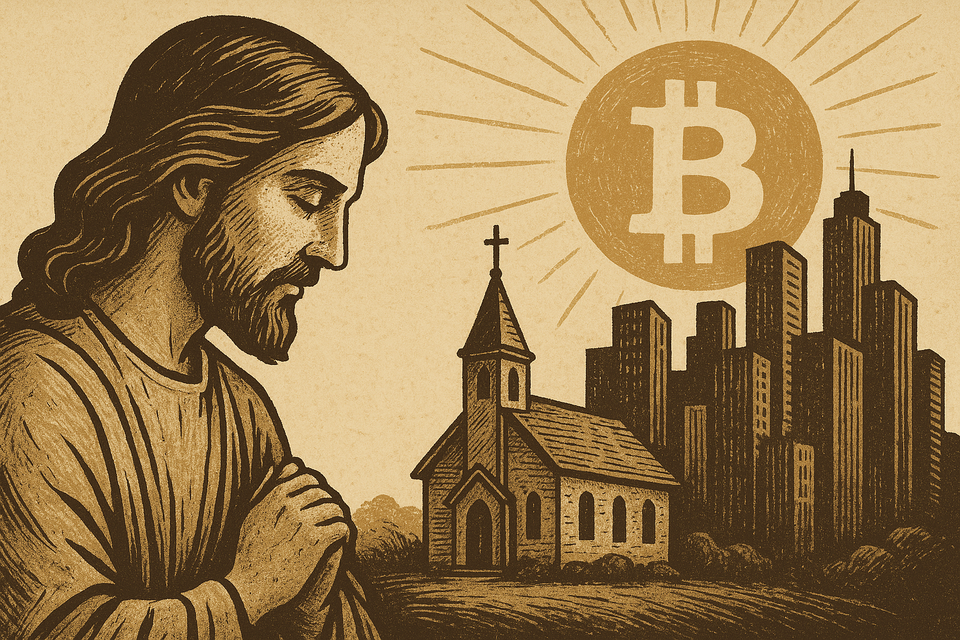
A serene Jesus, a modest church, and a radiant Bitcoin symbol rise above a modern skyline—symbolizing the quiet strength shaping Bitcoin’s future. Illustration created using Image Generator GPT via ChatGPT.


On a cold Sunday morning in a small stone church squeezed between the mirrored facades of downtown high-rises, a line of scripture rose into the air like an unexpected challenge: “Blessed are the meek, for they shall inherit the earth.”

The words hung there, suspended in the stillness. Most of the congregation bowed their heads with the practiced serenity of people who have heard these beatitudes every week for decades. But one listener, Elias, a software engineer who spent his nights volunteering at a Bitcoin meetup, felt a pressure building behind the simplicity of the phrase, as if it were aimed directly at him.

He had not expected this. Only the night before, he’d stayed up until 2 a.m. responding to frantic messages from first-time Bitcoin holders watching a violent price crash. Some had invested rent money. Others had been duped by influencers promising “guaranteed gains.” Elias had tried to reassure them, typing slowly, carefully, resisting the urge to lash out at the stupidity or carelessness of people he genuinely wanted to help.

By dawn, he felt wrung out. And now, in this quiet sanctuary, he found those words, Blessed are the meek, cutting through the exhaustion with unsettling precision.

At The Bitcoin Pivot, we have always tried to chart the deeper shifts shaping Bitcoin’s trajectory. But rarely do those shifts begin in places as quiet as a church pew or as personal as a moment of exhaustion and doubt. Yet these, too, are pivot points, the ones that redefine how a movement understands itself.

For Elias, meekness felt like a rebuke. He knew the caricature of Bitcoin culture: militancy, maximalism, ego in its purest digital form. He had seen smart people turn vicious online, had watched debates devolve into character assassinations, had witnessed newcomers crushed under the weight of irresponsible advice. He had internalized the idea that surviving in this world required hardness.

But as he sat in that pew, another memory surfaced, one he had worked hard to forget.

It was 2018, during a catastrophic crash that erased billions in value in a matter of days. Elias had lost far more than he could afford. He remembered the panic that clawed at his throat, the shame of telling his partner, the helplessness of watching months of careful saving evaporate. He remembered the isolation of those nights, staring at charts that felt like judgment.

What saved him then was not bravado, not defiance, not the chest-thumping conviction celebrated online. It was a quiet conversation with a developer he barely knew, someone who answered his message at 3 a.m. with gentleness, not condescension. Someone who told him, “Markets don’t shape your worth. Panic is not a verdict. Start where you are.”

That person, anonymous, humble, uncelebrated, kept him from walking away from Bitcoin entirely.

Sitting in the church now, Elias realized that this was meekness: strength without spectacle, conviction without cruelty.

And he wondered, what if this virtue, dismissed as irrelevant in the modern world, was the very thing Bitcoin needed to mature?

Meekness in the spiritual tradition is a fierce discipline. Christ calling Himself “meek and lowly in heart” was not an admission of weakness but of unshakeable stability. St. John Climacus described meekness as a fortress against the storms of anger, a mind unmoved by praise or humiliation. It is moral ballast, psychological architecture, emotional resilience.

Bitcoin’s history is full of moments that tested that resilience. The block-size wars fractured friendships and nearly shattered the community. Mt. Gox annihilated trust and financial security. Flash crashes sent thousands spiraling into despair. Every cycle, the same forces emerged: envy, fear, triumphalism, fury. The apostles would have recognized this landscape instantly.

Yet Bitcoin survived not because of those who shouted loudest, but because of those who refused to be shaken.

It survived because developers quietly reviewed code through the night. Because educators patiently guided panicked newcomers through their first hardware wallets. Because contributors absorbed insults and kept writing documentation anyway. Because ordinary holders clenched their teeth through downturns and stayed committed to principles rather than emotions.

Bitcoin’s architecture mirrors meekness in code. It does not coerce; it persuades. It does not centralize force; it distributes responsibility. Nodes do not impose will; they verify truth. Consensus emerges not through domination but through patience, block by block, confirmation by confirmation, cycle by cycle.

Still, culture is harder to civilize than protocol.

The emotional stakes of Bitcoin are immense. People tie their self-worth to their portfolios. They bet futures they cannot afford to lose. They attach identity to ideology. And when markets collapse, the psychological fallout is real: sleepless nights, hidden shame, relationships strained under silent financial pressure.

These are not abstractions. They are the stories Elias heard every week from strangers who had lost their footing in the volatility. People who needed gentleness, not judgment.

And so the question becomes unavoidable: If Bitcoin is to become a stabilizing global asset, who will shepherd it there? Those who weaponize conviction, or those who temper it? Those who build platforms for themselves, or those who build pathways for others?

For Elias, the pivot happened not on a chart or a message board but in that pew, beneath the weight of a simple sentence. He realized that the most influential people in Bitcoin’s future might be the ones no one notices, the ones teaching calmly during market fear, reviewing code for no reward, answering midnight messages with compassion. The ones who refuse to let ego become architecture.

Bitcoin’s greatest pivot is not technological. It is cultural. And it is happening in moments like these: quiet, human, unglamorous, but decisive.

Closing Reflection: The Quiet Turn We Cannot Afford to Miss

At The Bitcoin Pivot, we believe that revolutions are kept alive not by ideology but by character. The next phase of Bitcoin’s evolution will not be shaped solely by hash rate, policy, or macroeconomics. It will be shaped by how its community confronts fear, anger, envy, and pride, by the emotional architecture that undergirds the technology.

Meekness offers the antidote to the very forces that threaten Bitcoin from within. It offers steadiness in volatility, patience in uncertainty, and clarity in the face of noise. It is not weakness. It is the refusal to let panic or ego dictate the future.

If Bitcoin becomes a foundation stone of a new financial era, it will be because unassuming contributors carried it there, those who build with humility, those who educate without ego, those who stay when others shake, and those who answer strangers’ midnight messages with a gentleness the world has forgotten how to value.

The meek will not inherit the blockchain by seizing it. They will inherit it because they are the only ones steady enough to hold it.

At The Bitcoin Pivot, this is the quiet turning point we are committed to tracing, because it may define the future more profoundly than any price movement ever will.